Parenting Tips for Teens: Talking So Your Teen Will Listen
If you’re parenting a teenager, you know communication with teenagers can be tricky. Adolescence comes with multiple high-risk challenges, from academics and planning for the future to social pressure and dating. In addition, adolescence is a crucial time for identity development, with teens discovering more about who they are and who they want to be. As parents, we want to make sure our children navigate these challenges wisely. We have important life lessons to pass on as we try to help them learn from our victories and avoid our failures. Yet, in the middle of these important conversations, many parents find their teens tuning out. They don’t seem to be listening, they roll their eyes, or maybe they don’t even look up from their phones. As a therapist who has worked with both teenagers and parents, I’ll include insights from the research and from my clinical work to provide three therapist-proven strategies to increase the likelihood of your teenager engaging with you in these complex conversations. In this post, we’ll discuss improving listening before giving advice, emotional validation, and leading by example to foster a stronger, more supportive relationship with your child.
Causes of Stress for Teenagers
Adolescence is one of the biggest transition periods in life. Puberty brings not only physical changes, but a slew of cognitive ones as well, which makes their lives much more complex. It’s like the blindfold has been taken off and they are bombarded by the real world. At the same time, teenagers experience a “spotlight effect” in which they feel they are always being watched. They fear that their every mistake will be seen by you, by their peers, or by the world. And, in a way, they’re not wrong!

Teens are navigating a myriad of changes in all domains of their life, all of which have long-lasting impacts. These might include:
- Exploring their identity
- Figuring out where they fit in socially
- Dating (or not dating) and Sexuality
- Social media
- Learning to Drive
- Managing High Expectations from Adults (parents, coaches, etc.)
- Increased Academic Difficulty
- New temptations
- Planning for the future… and more
Teenagers are frequently overwhelmed, with a 2023 NIH report showing over 20% of teenagers experiencing diagnosable anxiety or depression. Despite their nonchalance, teenagers are often looking for and longing for connection with adult mentors. At the same time, parents often feel frustrated with feeling like their teen won’t engage with them on these important topics. In my experience as a therapist, I’ve worked with parents and with teens and I want to share with you the key mistakes I see parents making and the parenting tips you can use to correct these mistakes.
Three Parenting Tips for Communicating with Teenagers
Tip #1: Listen First (Why Lecturing Your Teen Usually Backfires)
The biggest mistake parents make when talking to teens is lecturing to them. I want you to imagine for a moment that you are talking to a friend about a problem at work. Before you can even start talking about it, your friend interjects and starts to boss you around. “You really need to just quit that job. You complain about it constantly and it’s time to move on.” You’d likely feel pretty frustrated.
Most of us need conversation in safe relationships to explore our ideas and figure out what we want. Teenagers need the same thing. You may know the right answer to the problem, but if you jump straight to the solution, you don’t give them the opportunity to explore it for themselves. You’re not just solving one problem, but teaching them ways to solve problems. Additionally, refrain from telling stories about your teen years. Adults seem to think that’s helpful – it’s almost never helpful. This conversation is about them, not about you.
Start by putting aside distractions and being focused on the conversation. It’s ok to have a little distraction, like folding the laundry or driving a car. Not having to make direct eye contact can help some teens feel more comfortable. But if you’re answering work emails, don’t expect your child to be listening to you. Don’t interrupt, jump to conclusions, nor try to speed along the conversation. Just listen and ask open-ended questions that show you were paying attention – what did you think about that? What do you think she meant when she said that? Didn’t that teacher give you a hard time last week too?
Tip #2: Use Validation to Calm the "Emotional Brain"
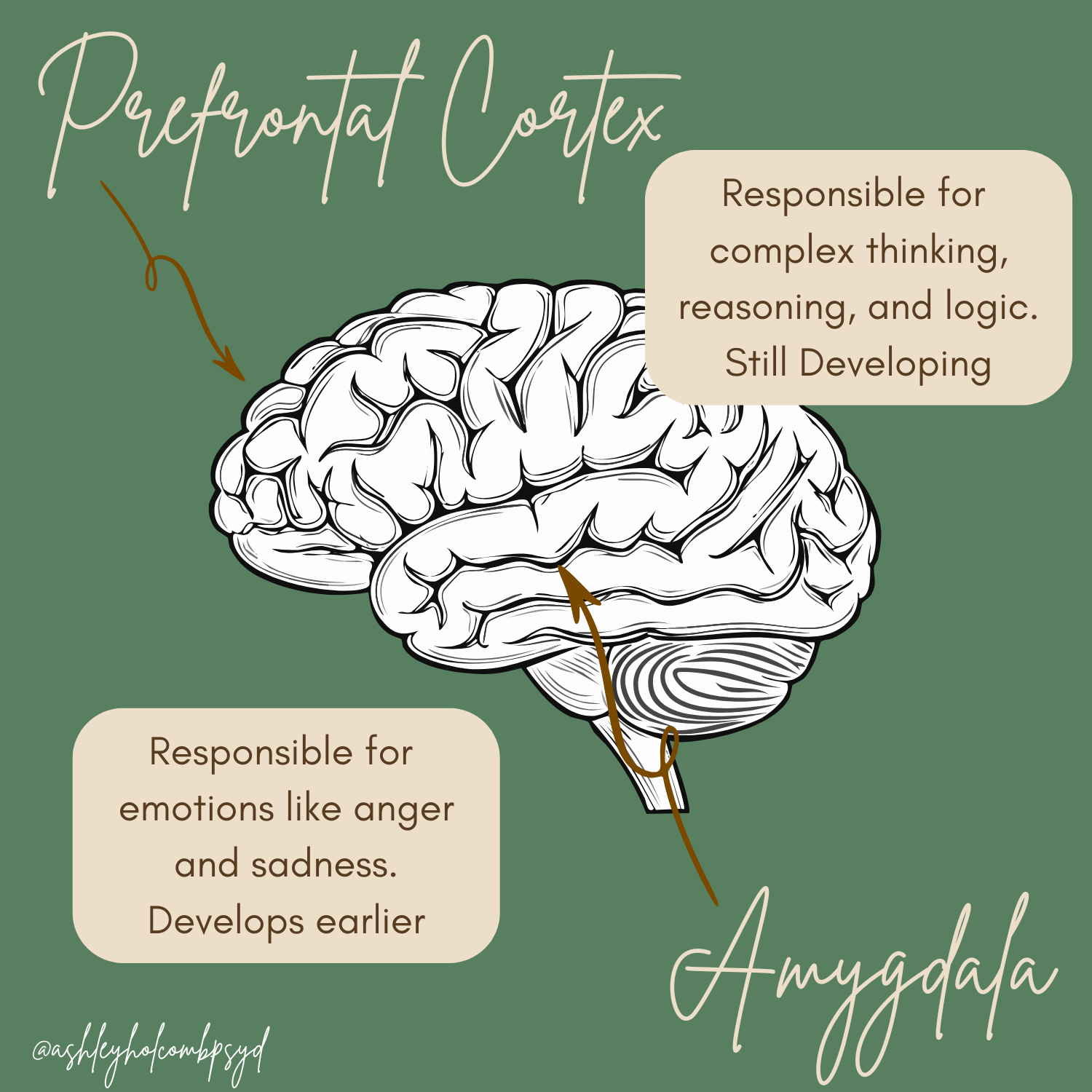
Adolescence is a particularly dramatic time in a person’s life, where emotions are incredibly intense and every situation seems much larger than it actually is. At the same time, they are navigating one of the most difficult transitions of life that can have some very high stakes. It can be tempting to correct any exaggerations – I highly doubt you’ll fail at everything you do. Well, at least you don’t have to pay bills. I’m sure it will be fine. Youth is wasted on the young. Problem is, their teen brains haven’t fully integrated the thinking center of their brain (the prefrontal cortex) with the feeling center of their brain (their amygdala). What’s happening is their feeling brain is taking over and overriding their logic. What they really need is support to calm down their feeling brain so that their thinking brain can come back online. You can do this by keeping a calm body posture and tone of voice, listening first, and validating their feelings (even if you don’t agree).
The key to these conversations is to validate their feelings without agreeing with their conclusions. You can say something like, “I’m so sorry that happened” or “it sounds like you’re feeling worried about this” or “It makes sense that this hurt your feelings.” Give them space to be upset. Then wait for it. There’s this moment where they breathe again and their shoulders feel lighter. The storm seems to have cleared. IF AND ONLY IF you feel it is necessary to correct them in some way, this is your moment. Ask, “can I give you some advice?” If they say “no,” don’t give it. Trust that they know you have some advice to give and they’ll come to you if they want it. If they say “yes,” then you can gently correct their perceptions.

Tip #3: Modeling Behavior—Why Teens Are Allergic to Hypocrisy
Teenagers are allergic to hypocrisy. They do not listen to adults they don’t respect. And teens are a LOT more observant than adults think they are. They see that you have a drinking problem, or a social media addiction, or trouble keeping a job. If you are going to tell them they have to follow a particular rule, you also have to follow that rule. You want them to not look at their phones at the dinner table? You also have to not look at your phone at the dinner table. You can say things like, “I’m the adult, I get to do XYZ” all you want. It may win the temporary argument, but it will lose the respect of your teen. When you practice what you preach, you are building credibility. Why should they listen to you with this problem if you have the same one?
Finding Support: Parent Coaching and Therapy in Clovis, CA
Though they may not show it, your teen needs you. They need your help, not to navigate these immense challenges for them, but to support them as they find their own voice. At times, they will make decisions you disagree with. At times, you’ll see sides to them that you don’t like (maybe ones you even see in yourself). They will fall. They will fail. But if you have a supportive relationship with your teen, they will also know that they can trust you to help them get back up and try again. And they will know that they never fail alone. Figuring all of this out by yourself can be hard – especially if it’s different than how you were parented. Many situations also have nuances that require a more specialized approach. Consider reaching out to a therapist who specializes in parent coaching. If your teen already sees a therapist, you can also ask them for advice or for a referral. You don’t have to do this alone. If you’re in Clovis, CA or open to telehealth in California, I’d love to help. Learn more parenting tips and tools and take the first step to a better relationship with your teen today.
References:
Bandura, A. (1977). Social learning theory. Englewood-Cliffs, NJ: Prentice-Hall.
Buckholdt, K. E., Parra, G. R., & Jobe-Shields, L. (2014). Intergenerational Transmission of Emotion Dysregulation Through Parental Invalidation of Emotions: Implications for Adolescent Internalizing and Externalizing Behaviors. Journal of Child and Family Studies, 23(2), 324–332. https://doi.org/10.1007/s10826-013-9768-4
Coughlin, R. (2024, August 8). Talking with Your Teen: 10 Tips for Meaningful Connection. The Gottman Institute. https://www.gottman.com/blog/talking-with-your-teen-10-tips-for-meaningful-connection
Linehan, M. Cognitive–behavioral treatment of borderline personality disorder. New York: Guilford Press; 1993.
Sappenfield, O., Alberto, C., Minnaert, J., Donney, J., Lydie Lebrun-Harris, & Ghandour, R. (2024, October). Adolescent Mental and Behavioral Health, 2023. Nih.gov; Health Resources and Services Administration. https://www.ncbi.nlm.nih.gov/books/NBK608531/
Trauma Responses. (2026). Ramsey Solutions. https://www.ramseysolutions.com/personal-growth/what-is-trauma/trauma-responses?srsltid=AfmBOoqfGBtC-DN941w-AWSGr4rtCrNLlerXSTT3a7lTZ9rATwY2KKxo
World Health Organization. (2025, September 1). Mental health of adolescents. World Health Organization. https://www.who.int/news-room/fact-sheets/detail/adolescent-mental-health
