Why do I keep dating emotionally unavailable people?
We all have a type, but for some, that type is a cyclical pattern of chaos and drama. Many people find themselves asking, "Why do I keep dating emotionally unavailable people?" only to find the same patterns repeating regardless of the partner. This blog explores the concept of attachment—our foundational orientation to relationships—and how these internal maps may be directing you toward unhealthy connections. Understanding these patterns is the first step toward breaking the cycle.
The Tl;dr:
Attachment is our foundational orientation to relationships, initially developed within the first year of life and based on our relationships with caregivers
An anxiously-attached individual is likely to take on a “caretaker” role, often ending up in relationships with individuals with substance use or behavioral problems.
An avoidant individual is likely to distance themselves from emotional connection or conflict, ending up in relationships where they feel smothered and overwhelmed.
What is attachment?
Attachment initially develops within the first year of life and is influenced by other relationships throughout our life. Within this first year of life, a child gains a foundational understanding about themselves and other people. Are other people safe? Are they good? Am I good? Our attachment involves our very basic instincts about our own worthiness, other people’s intentions, and how we relate to others.
These basic instincts about worthiness and others' intentions form a "blueprint" for adult life. If those early experiences were inconsistent or dismissive, you might find yourself unconsciously reenacting those same dynamics in your adult romantic life.
Attachment Styles
From a clinical perspective, what looks like "bad luck" in dating is often a survival strategy learned in childhood.
Before we get started, consider taking this Free Attachment Quiz to find out your attachment style.
Anxious Attachment
Anxious Attachment often stems from having a highly critical parent or one who required the child to take care of them. You learned to caretake for others to avoid being criticized or to gain praise. You probably were told you were “good”, “responsible”, and “empathic,” which reinforced the idea that caretaking for others is the best way to exist within a relationship. You may feel emotionally overwhelmed and responsible when someone else is upset. You may feel you have to fix other people’s problems.
As an adult, you may feel you must "fix" others or minimize your own needs to be valued. You may end up in codependent relationships, which are inherently one-sided. The problem is, healthy romantic relationships are not meant to be one-sided. They are meant to be equal relationships. As much as you are emotionally available, in reality, you are hiding behind caretaking. You may feel you need to be the caretaker for someone in order to feel a sense of value. You may pick people who require a lot of care, such as a person with an active addiction or with behavioral problems. You likely make excuses for them, telling others that they have been through a lot and just need to be loved. The problem is, your caretaking may actually decrease the likelihood that they will change. They continue to act out, use a substance, or eschew responsibility because you will always be there to clean up their mess. You long for the day where they notice how hard you work for them and they turn it all around. And maybe there are little hints of that – a special vacation or a gift – but the overall picture of the relationship is of them taking advantage of your caretaking nature.
In therapy, you probably find it easy to talk about your feelings and concerns about the relationship. However, you will likely find it very hard to enact the changes that the therapist is suggesting. It may take you some time to become comfortable with setting boundaries (or even leaving unhealthy relationships).
Avoidant Attachment
This style often develops when a parent is dismissive or angry when a child expresses needs. Consequently, you may view dependency as a weakness and struggle with the vulnerability required for a real relationship. The people you loved most and needed most were harsh when you needed something. It makes sense that you would want to be independent.
At the same time, you long to be close to others. You likely have a rich fantasy life about the perfect partner who understands and sees your needs without you having to talk about them. The problem is, no relationship can live up to that fantasy. Real relationships have conflict and conflict requires communication, openness, and vulnerability. If you feel like emotions, vulnerability, or having needs are threats, normal conflicts may feel incredibly overwhelming. If you have a need and it is unmet, you may find yourself getting increasingly resentful that your partner isn’t meeting it. If your partner expresses a need, you may dismiss the need as “overbearing” or “needy” or shut down out of feeling overwhelmed.
If you have an avoidant style, you may be less likely to seek out therapy. After all, talking about your emotions vulnerably to someone sounds terrifying to you. Consider starting by reading some books about avoidant attachment or emotional awareness first. This could help you increase your comfort in acknowledging your emotions to yourself first. When you are ready, tell your therapist about your attachment and ask them to work with you to find a pace in therapy that works for you.
The Pursuer-Distancer Dynamic
It’s common for anxious and avoidant individuals to date one another. The anxious person likes how independent and “strong” the avoidant appears, all the while longing to be the one to “fix” the avoidant partner’s deep-seated wounds. The avoidant partner initially likes being chased by the anxious partner, and may like how good the anxious individual is at guessing their needs. However, this pairing breaks down quickly. The avoidant person quickly feels smothered by the anxious individual’s caretaking attempts and the anxious person feels constantly ignored. The anxious person may try to drag the avoidant individual to couples therapy, but they may not be able to make much movement until each person works on their attachment style in individual therapy first.
Interested in learning more? Check out the Gottman Institute’s Article on the The Pursuer-Distancer Dynamic.
Attachment Style Comparison
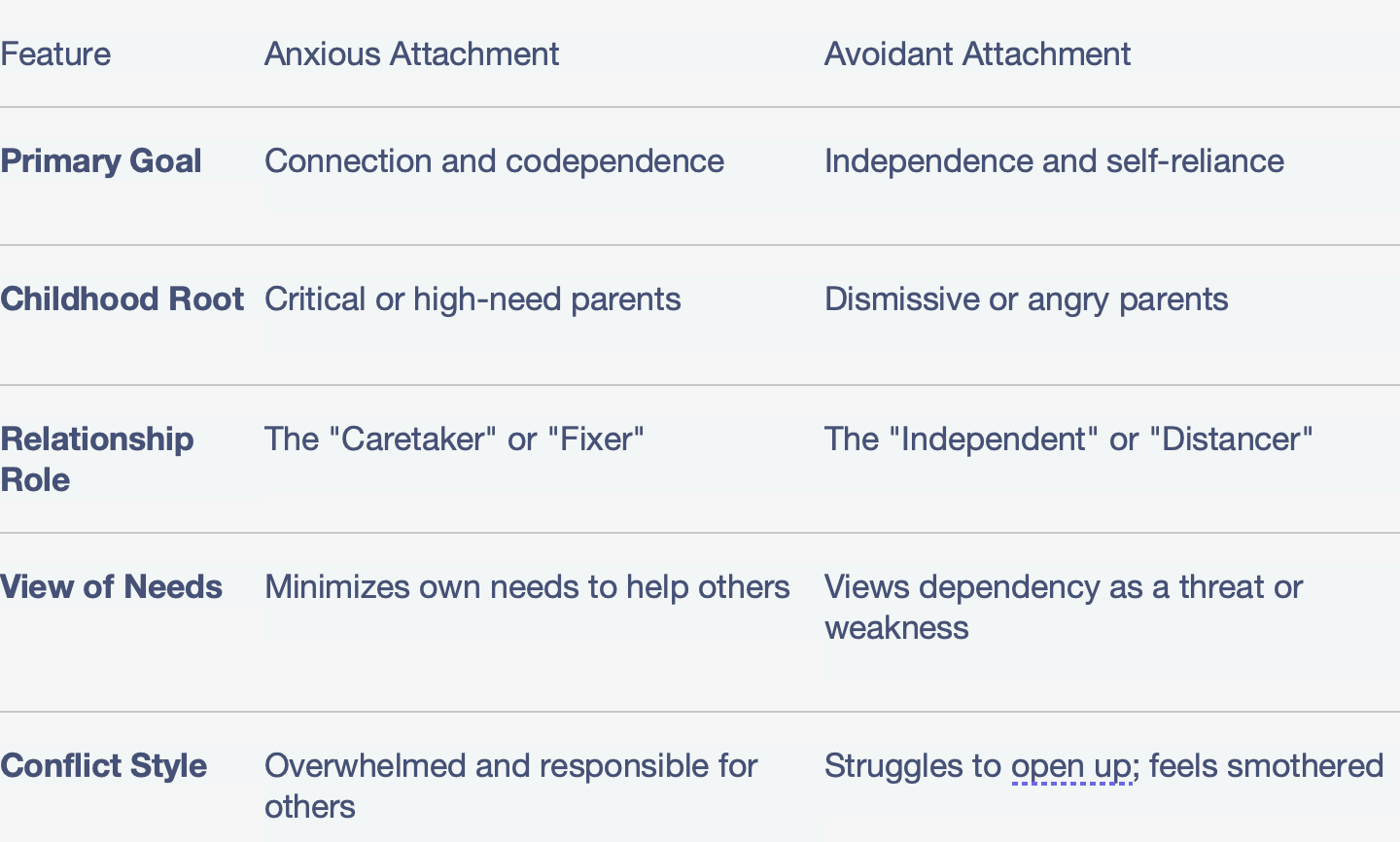
Provides a chart reviewing differences in goals, childhood experiences, relationship roles, views of needs, and conflict style between individuals with anxious and avoidant attachments.
What’s the Alternative? Secure Attachment
Individuals with a secure attachment had parents who were caring, but firm, balancing warmth and attunement with structure and reasonable expectations. Secure individuals grow up to be confident, competent, independent, and friendly. They assume others have good intentions, but know how to set limits and walk away from relationships that are unhealthy.
This isn’t to say they won’t experience relationship problems. Even two securely attachment individuals engage in conflict, because conflict is a normal part of relationships. But how they engage in conflict and the outcome of the conflict may look different – they are more likely to “fight fair” and more likely to come to a healthy resolution to the problem.
Learn more about how secure individuals do conflict from this TED Talk with the Gottmans.
Can attachment change over time? Or am I doomed??
Though the foundation for your attachment style begins in your first year of life, it does not mean you are doomed to a life of unhealthy relationships. It means you may need to spend some time working on understanding your attachment and learning new ways of responding to others.
For Anxious Individuals: Focus on setting firm boundaries. Recognize that "caretaking" can actually prevent your partner from changing, as they never have to face the consequences of their actions.
For Avoidant Individuals: Start small by reading about emotional awareness to increase your comfort with your own feelings. Practice asking for space when you feel overwhelmed rather than simply withdrawing.
In addition, your attachment style can worsen over time based on unhealthy relationship experiences. If you’re not dating, pay attention to your other relationships and the influence they have on you. Are they normalizing or even encouraging unhealthy relationship behaviors?
You don’t have to navigate these deep-seated patterns alone. Whether you are struggling with boundaries or fear of intimacy, professional support can help you rewrite your relationship story. Ready to stop dating emotionally unavailable people? Reach out today to begin your journey toward secure attachment.
Stay Tuned for my next blog: Fostering Healthy Attachment in your Children
Frequently Asked Questions (FAQ)
Can I change my attachment style? Yes. While attachment styles are foundational and developed in early childhood, they are not a life sentence. Through therapy and intentional practice, individuals can learn to relate to others differently and move toward "earned" secure attachment.
Why do anxious and avoidant people often date each other? It is a common cycle where the anxious person seeks connection through caretaking, while the avoidant person's distance triggers the anxious person's need to "fix" the relationship. This often results in a loop where one person feels smothered and the other feels neglected.
How do I know if I'm dating someone emotionally unavailable? Common signs include a partner who eschews responsibility, struggles with vulnerability, or relies on you to "clean up their mess" while offering little emotional support in return.
